

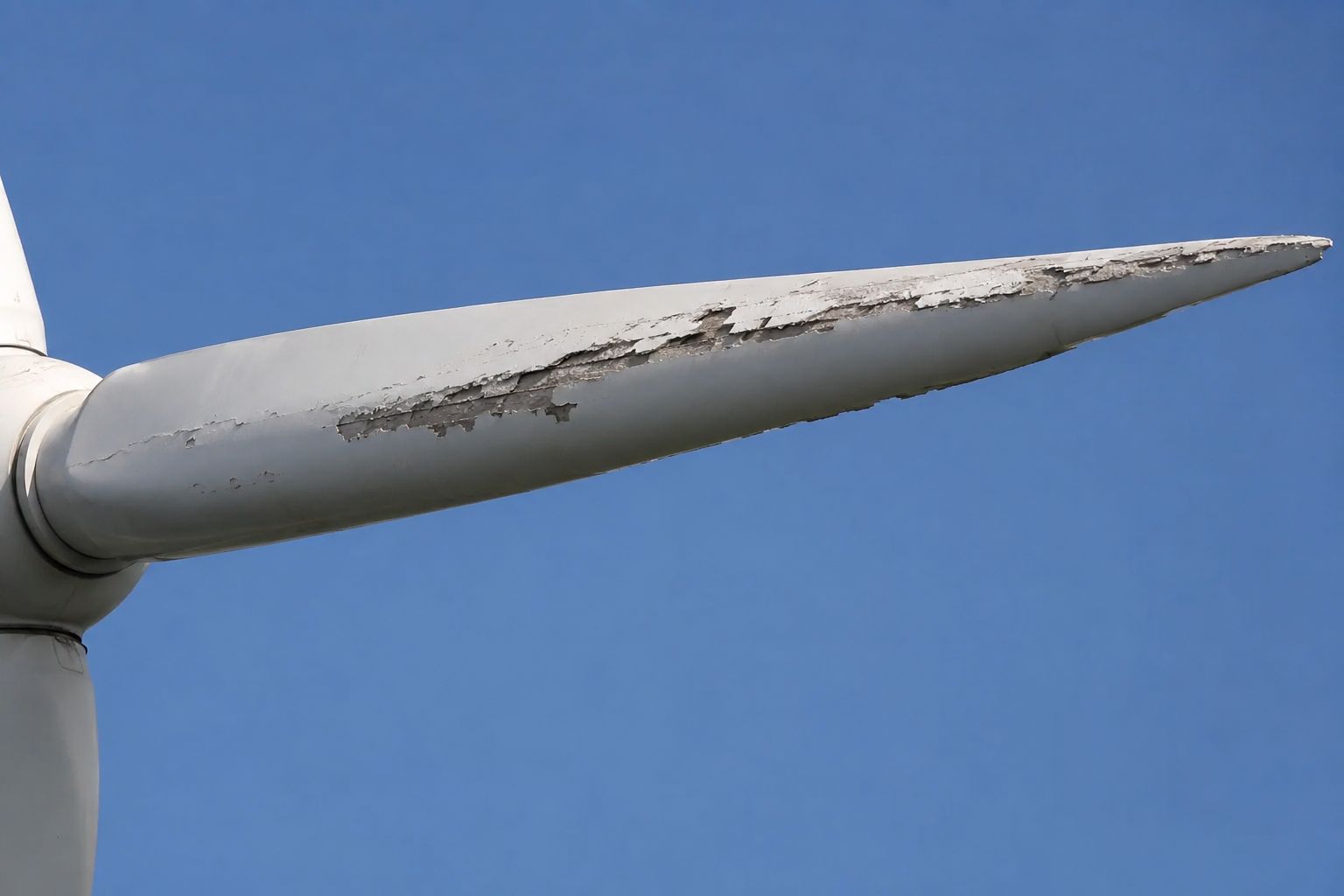
Wind energy is routinely marketed as a mature, reliable technology. Yet beneath the polished renderings of spinning turbines lies a persistent engineering headache that receives far less public attention than it deserves: leading-edge erosion. Over years of operation, the front edge of a turbine blade is repeatedly struck by raindrops, hailstones, sand, insects, and dust at speeds that can exceed 300 km/h at the blade tip. The cumulative effect is a slow but serious degradation of the blade surface — one that quietly eats into the economics and reliability of wind power.
What Erosion Actually Does to a Blade
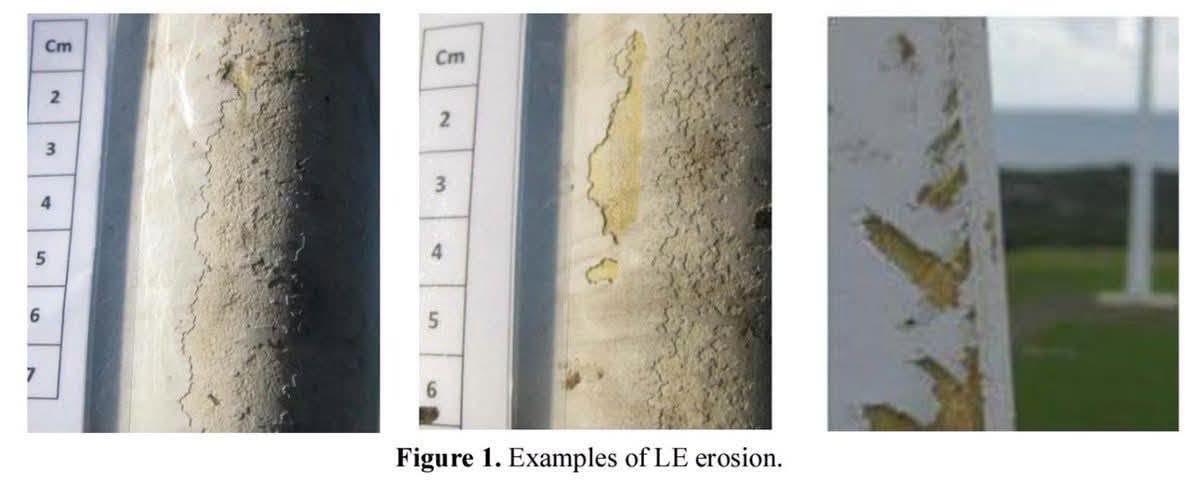
Leading-edge erosion begins as pitting and small cracks in the protective gelcoat or paint layer covering the blade’s composite structure. Left unaddressed, it progresses to exposed fibers, delamination, and eventually structural damage to the blade itself. A review from the Technical University of Denmark’s Department of Wind Energy describes surface erosion as one of the genuinely critical problems facing the wind energy sector, noting that it stems from a complex mix of meteorological, aerodynamic, and materials-science factors that researchers are still working to fully characterize.
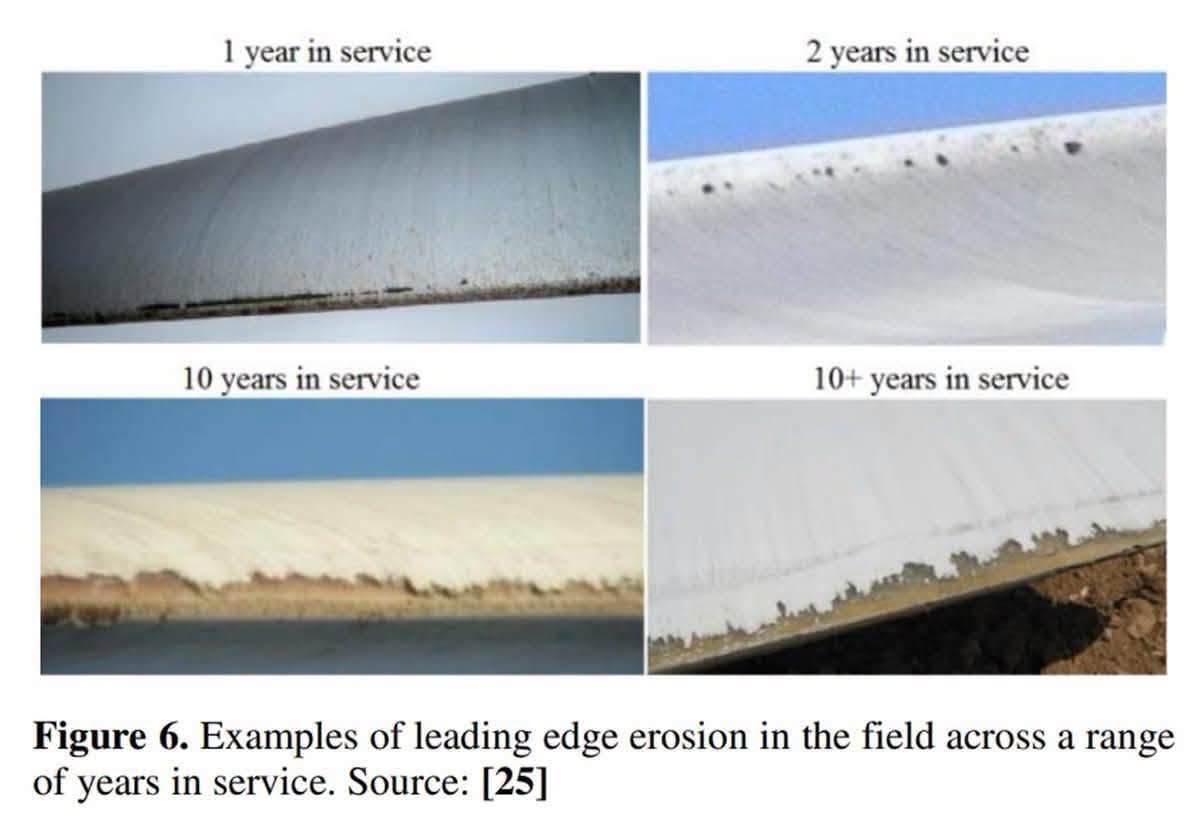
Researchers at the University of Strathclyde modeled how rain droplets and hailstones damage blades differently depending on the coating system used. Their analysis found that for conventional gelcoat coatings, rain exposure creates a genuine risk of surface degradation, while newer, more flexible erosion-resistant materials are instead prone to interface damage and debonding from the underlying substrate. The same study warned that sufficiently large hailstones could cause significant damage to the composite structure beneath the surface, not just the coating.
The Performance Penalty Is Not Trivial
The erosion problem would be a minor maintenance nuisance if it only affected appearance. It doesn’t. It measurably reduces how much electricity a turbine produces.
Sandia National Laboratories, the U.S. Department of Energy’s own research arm, found that leading-edge erosion begins degrading aerodynamic performance as early as the second year of a turbine’s operation, and that a heavily eroded blade can cut annual energy production by as much as 5% on a utility-scale turbine. That is not a rounding error — across a wind farm’s operating lifetime, a 5% shortfall represents a substantial loss of revenue and a real dent in the promised return on investment.
Independent field research has produced figures that are, if anything, more alarming. A 2023 study published in Wind Energy used infrared-camera imaging combined with SCADA and meteorological data to quantify real-world losses and found that turbines suffering leading-edge erosion lost between 3% and 8% of their expected power output. A separate probabilistic analysis combining computational fluid dynamics with uncertainty modeling estimated average annual energy losses of around 2% offshore and 3% onshore, while a ten-year wind farm simulation published in Wind Energy Science found that erosion-related losses could climb to nearly 3% by the final year of the simulation as damage accumulated. The spread between these estimates itself points to a deeper issue: erosion rates and their aerodynamic consequences are still difficult to predict reliably, which makes it hard for operators to plan maintenance or forecast output with confidence.
Maintenance Costs Are Spiraling
Lost energy production is only half of the financial story. The other half is the cost of inspecting, repairing, and protecting blades against a problem that never fully goes away.
A European Commission–backed research project on wind turbine blade erosion notes that annual operations and maintenance costs across the European wind sector already run to roughly €5.8 billion, and identifies erosion caused by particle collisions as a significant contributor to that bill. A separate industry assessment estimated that, measured as net present value over a turbine’s operating lifetime, the total cost of blade erosion — combining lost energy and repair expenses — amounts to roughly 2–3% of the entire gross energy yield the turbine was expected to generate. For a technology sold to investors and governments on the strength of predictable, long-term returns, that is a meaningful and persistent drag.
Offshore wind farms face an even harsher version of this problem. Turbines at sea are exposed to near-constant moisture, salt spray, and higher wind speeds, and repairing blades offshore requires specialized vessels, favorable weather windows, and technicians working at height above open water — all of which make offshore blade repairs dramatically more expensive and logistically fragile than onshore work.
An Industry Still Struggling to Model the Problem
What should concern policymakers and investors as much as the raw numbers is how much uncertainty still surrounds them. A 2023 review of leading-edge erosion research points out that the unpredictability of field-recorded erosion damage presently prevents operators from confidently using that data to improve maintenance planning or forecast energy yield — undermining one of wind energy’s core selling points: predictability.
Newer computational approaches are attempting to close that gap. A recent peridynamics–discrete element modeling study set out specifically to address what its authors call the critical issue of leading-edge erosion caused by solid particle impacts, aiming to better predict how coatings fail under repeated impact. Meanwhile, an EU-funded project acknowledged that even basic questions about how turbulent, particle-laden wind actually damages blades remain incompletely understood, which is precisely why it is developing new sensor technology to map the problem. In other words, more than a decade after leading-edge erosion was first flagged as an industry-wide concern, researchers are still building the basic tools needed to predict and manage it reliably.
Why This Matters Beyond the Turbine
None of this is an argument that wind power is unworkable — but it is a strong argument against treating turbine performance and lifetime costs as settled, predictable numbers. Erosion-driven energy losses of 3–8%, compounding maintenance costs running into billions of euros annually, and computational models that researchers themselves describe as still immature all point to a technology whose real-world economics are less certain than headline capacity figures suggest. Grid planners, investors, and policymakers relying on projected output and levelized cost of energy figures should treat those numbers as optimistic ceilings rather than guarantees, until blade erosion is modeled and mitigated far more reliably than it is today.
References
- U.S. Department of Energy / Sandia National Laboratories — Research Led by Sandia Reveals Leading-Edge Erosion Significantly Reduces Wind Turbine Performance: https://www.energy.gov/cmei/systems/articles/research-led-sandia-reveals-leading-edge-erosion-significantly-reduces-wind
- Sandia National Laboratories — Leading Edge Erosion: https://energy.sandia.gov/programs/renewable-energy/wind-power/leading-edge-erosion/
- Keegan, M.H. et al., University of Strathclyde — Wind Turbine Blade Leading Edge Erosion: An Investigation of Rain Droplet and Hailstone Impact Induced Damage Mechanisms: https://pureportal.strath.ac.uk/en/publications/wind-turbine-blade-leading-edge-erosion-an-investigation-of-rain-/
- Mishnaevsky, L. Jr. et al., Technical University of Denmark — Leading edge erosion of wind turbine blades: Understanding, prevention and protection, ScienceDirect: https://www.sciencedirect.com/science/article/abs/pii/S0960148121000501
- Panthi, K., Iungo, G.V. — Quantification of wind turbine energy loss due to leading-edge erosion through infrared-camera imaging, numerical simulations, and assessment against SCADA and meteorological data, Wind Energy (2023): https://onlinelibrary.wiley.com/doi/full/10.1002/we.2798
- Probabilistic analysis of wind turbine performance degradation due to blade erosion accounting for uncertainty of damage geometry, ScienceDirect (2023): https://www.sciencedirect.com/science/article/pii/S1364032123001107
- Visbech, J. et al. — Aerodynamic effects of leading-edge erosion in wind farm flow modeling, Wind Energy Science (2024): https://wes.copernicus.org/articles/9/1811/2024/
- IEA Wind — Erosion of Wind Turbine Blades (Technical Expert Meeting proceedings): https://iea-wind.org/wp-content/uploads/2023/05/98_TEM-Blade-Erosion_Proceedings_v21.pdf
- European Commission, CORDIS — WITE: Wind turbine blade erosion with particle-laden atmospheric flow: https://cordis.europa.eu/project/id/101211141
- PD–DEM hybrid modeling of leading edge erosion in wind turbine blades under controlled impact scenarios, PMC: https://www.ncbi.nlm.nih.gov/pmc/articles/PMC11442505/